
Founder’s Guide to assess whether your business needs a Branding Agency or Digital Marketing

Most founders don’t debate about branding versus marketing. They lie awake wondering why growth feels harder than it should. Why business spending keeps increasing but outcomes feel inconsistent, fragile, or short-lived.
The confusion isn’t about concepts; it’s about results. And in that uncertainty, it’s easy to reach for the convenient solution being pitched rather than pausing to understand the real problem underneath.
At 30TH FEB we believe that branding does feel like hard work because it forces businesses to think deeply before they act quickly. It demands clarity before activity. And that discomfort often pushes founders to skip the thinking and move straight to execution.
This guide is not a checklist of services. It’s a decision framework, a thinking roadmap to help the founders get clarity on what the business needs at a given moment.
It is critical because it sets the process straight and saves a lot of cost for the businesses that end up spending in marketing campaigns without fixing the core brand and messaging for the business.
Because the smartest growth decisions don’t start with who and how to leverage the growth, they start with what truly needs fixing.
So why does this question keep coming up for founders?
Businesses today operate under constant pressure to show traction – quick wins, visible numbers, upward graphs. Digital marketing promises speed and immediacy but unless planned – they are short-lived. Branding promises long-term value and differentiation.
On paper, both feel essential. In reality, few businesses have the budget or bandwidth to invest deeply in both at the same time.
The result is often fragmented execution:
- ads running without a clear story,
- brand assets that don’t translate into conversions,
- messaging that shifts across platforms,
- and ROI that’s hard to justify.
Which brings us to the real question founders need to ask. It isn’t branding or marketing.
It’s what problem are you trying to solve right now and what kind of partner is actually equipped to solve it?
Understanding the Core Difference
Branding and digital marketing are often discussed together, but they solve fundamentally different business challenges.
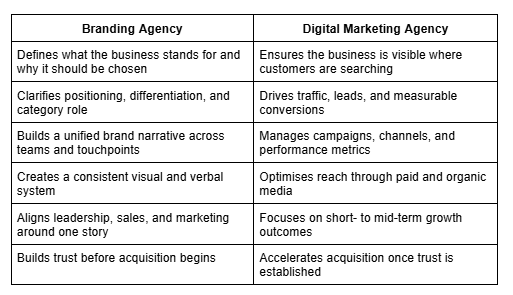
Branding shapes perception. Whereas Marketing amplifies it.
Amplification without clarity only magnifies confusion or becomes the hurdle in brand growth.
The Differences Founders Actually Experience in Real Business Situations
In real conversations with founders, the distinction rarely sounds as defined.
When branding gaps exist, founders often talk about symptoms like customers not really “getting” the business, sales teams explaining the offering differently each time, or the brand blending into a sea of sameness despite strong products or services. What is “not clicking” becomes so evident that it raises fundamental questions even if leads are coming in.
When marketing gaps exist, the concerns sound different. Founders talk about invisibility, not ranking in search, not being present in the right channels, or struggling to generate consistent inbound demand. The brand reach is minimised.
This is the practical difference founders feel every day.
When branding is weak, marketing is forced to explain instead of convert. When marketing is weak, branding struggles to reach the people it was built for.
What Happens When Founders Choose the Wrong One First
Many growth challenges intensify because the sequence is wrong.
We often see businesses run aggressive campaigns without clear positioning, leading to high spending and low recall.
We also come across brands that have genuinely strong products, but their messaging lacks focus, making it hard for customers to understand what makes them different. Inconsistent brand experiences across websites, social platforms, and sales conversations further dilute trust.
In these situations, growth may look promising on dashboards but experiences low loyalty, weak repeat behavior, and heavy dependence on constant spending.
Most of these are not marketing failures. They are clarity failures that surface as performance issues.
A Founder’s Self-Assessment Before Engaging Any Agency
Before deciding which kind of agency to hire, founders need to examine their own business honestly.
Ask:
- Can your team explain your value proposition consistently?
- Do customers choose you for a reason beyond price?
- Does your brand look and sound the same everywhere?
- Are leads coming but not converting?
- Is growth dependent on constant discounts or heavy spends?
- Are you entering a new market or audience segment?
Your answers will indicate whether you need clarity or reach or both. That too in the right order.
The Real Myth Isn’t Doing Branding and Marketing Together
The common misconception isn’t that branding and marketing can’t work together. They should.
The real risk lies in executing both simultaneously without a strategic core. When branding lacks depth, marketing teams are left guessing tone, voice, and positioning. Branding becomes decorative rather than foundational. Budgets grow, activity increases, but learning remains shallow because every campaign is solving the same foundational questions again and again.
At 30TH FEB, integrated brand management is not about parallel execution. It’s about continuity. We begin by clarifying the brand’s positioning, narrative, and decision filters. Once that foundation is set, marketing becomes an extension of strategy, not a separate function chasing metrics in isolation. Campaigns don’t just perform; they reinforce memory, trust, and differentiation over time.
Branding sets direction. Marketing builds momentum. And when the two are connected through intent and sequencing, growth compounds instead of resetting. We apply the same principle.
What Businesses Should Prioritise at Different Stages
Every stage of business growth demands a different kind of focus. What accelerates traction early on can slow momentum later if priorities don’t evolve with scale.
Here’s a clear picture of what to prioritise at different stages:
Early-stage businesses benefit most from clarity. At this stage, understanding the customer, defining the core message, and establishing positioning matter more than channel scale. Lightweight branding often delivers more value than heavy advertising.
As businesses scale, consistency becomes critical. Brand-led growth systems ensure that teams, markets, and partners speak the same language. Marketing then becomes an extension of strategy rather than an isolated function.
At mature growth stages, differentiation takes center stage. The brand story must support not just sales, but hiring, partnerships, and long-term credibility. Marketing works best when guided by a narrative that is already clear and aligned.
How 30TH FEB Approaches This Decision With Founders
At 30TH FEB, we don’t begin by recommending branding or marketing solutions. We begin by understanding why growth feels harder than it should.
That’s why our first step is always a brand audit, a diagnostic tool to surface where clarity is breaking down across the business. When positioning, messaging, leadership intent, and customer experience aren’t working in harmony, growth becomes expensive and absolutely unpredictable. We help identify those small gaps that sit quietly, preventing marketing from compounding.
Sometimes the business has outgrown its original positioning.
Sometimes the product has evolved but the story hasn’t kept pace.
Our role is often to surface what’s already working and identify where momentum is leaking.
Once direction is clear, momentum follows naturally. Whether that takes the form of brand building, marketing execution, or an integrated approach, the intent remains the same: build foundations that allow growth to sustain itself. Because long-term scale doesn’t come from doing more. It comes from doing the right things, in the right order, with clarity.
Choosing between a branding agency and a digital marketing partner is all about timing, clarity, and intent. When founders pause to diagnose before they accelerate, growth becomes more predictable, more efficient, and far more sustainable.
If your business feels ready to move but unsure where to start, sometimes the most valuable next step isn’t more execution but better clarity.