
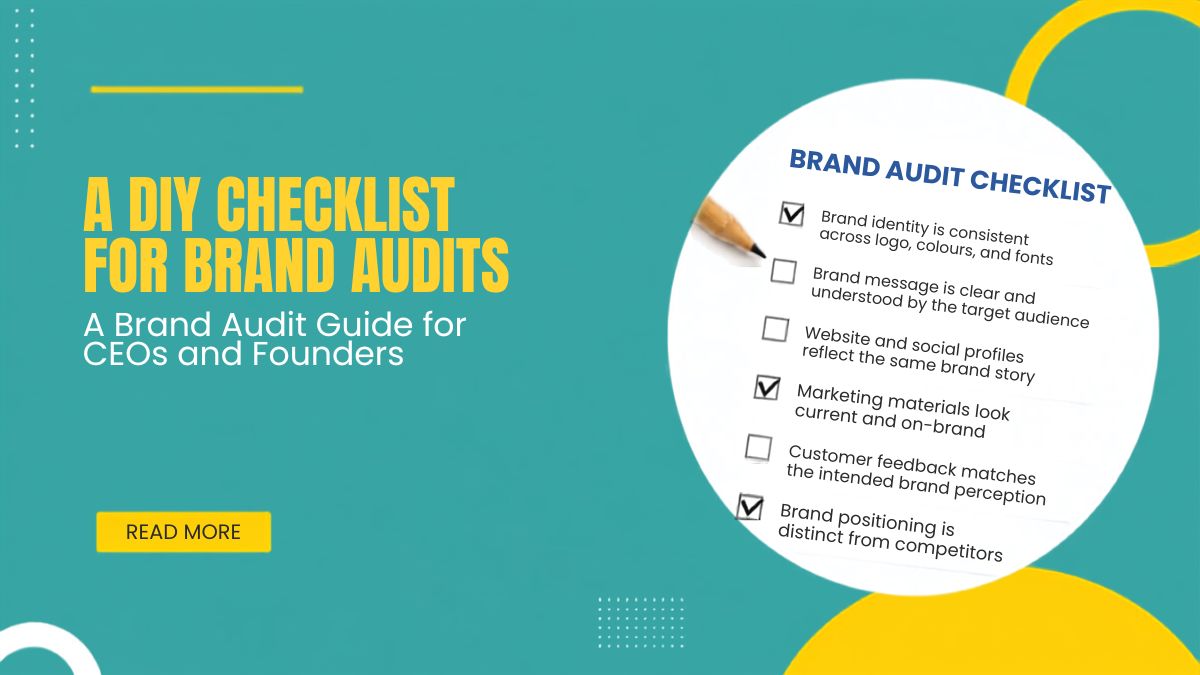
A DIY Checklist for Brand Audits. Use this as a Brand Audit Guide for CEOs and Founders
Top Summary Answer:
A brand audit is a structured review of your brand’s strategy, identity, messaging, customer experience, and market performance. It helps founders identify gaps, strengthen differentiation, and prioritize actions for brand growth.
Ask five people on your team, sales, support, marketing, even yourself, to describe the company in one sentence. Would any two answers match?
Most founders can quote last month’s revenue and churn from memory, yet go quiet the moment someone asks how the brand is actually landing in the market. Fair enough. A Profit & Loss statement is easy to read; perception isn’t. But the gap doesn’t stay harmless forever. Eventually a prospect walks away because they “weren’t quite sure what you do,” or a re brand gets crammed into six frantic weeks right before a funding round, simply because nobody looked closer sooner.
A brand audit closes that gap before it costs you something. And unlike most brand work, you don’t need an agency to start one. What follows is a practical, die-able walk through built for founders and CEOs specifically: what a brand audit covers, the signals that tell you one is overdue, a checklist you can run this week with no outside help, and the point at which calling in a brand consultant starts to make more sense than doing it alone.
What Is a Brand Audit?
A brand audit is a structured review of how your brand looks, sounds, and performs, internally (how consistently it’s built) and externally (how it’s perceived). It spans three layers: strategy (positioning, messaging), identity (logo, color, voice), and experience (website, packaging, sales materials), and ends in a prioritized set of recommendations, which is exactly what a proper brand audit and diagnostic should give you.
A marketing audit looks at channel performance: spend, conversions, ROI. A brand audit sits deeper, asking whether the thing being marketed is coherent in the first place.
Brand isn’t a design exercise, it’s a financial asset. It breaks into three ideas: brand awareness and image (how it lives in customers’ minds), brand equity (the commercial lift that creates, more willingness to buy, more price tolerance), and brand value (what that’s worth in dollars). An audit gives you visibility into all three instead of a guess.
Why Your Business Needs a Brand Audit
Companies accumulate inconsistencies nobody intended: mismatched logo files, several versions of the elevator pitch, a social tone that doesn’t match the annual report. An audit surfaces these systematically instead of by accident, and often shows why a good branding partner earns its keep.
It also forces an honest look at competitors, often revealing that a “differentiation” you’ve leaned on isn’t differentiating anything. And if you’re entering a new market or raising money, it tells you what parts of your brand architecture will stretch and what needs rebuilding, including naming, which is worth checking against a solid brand naming strategy.
Signs It’s Time to Conduct a Brand Audit
- Declining lead quality – you may be attracting or filtering for the wrong audience.
- Inconsistent messaging – sales, support, and marketing describe the company differently.
- Weak differentiation – customers confuse you with competitors or can’t say why they chose you.
- Falling trust – softer reviews, more price objections, fewer repeat buyers.
- Growth or re branding – a merger, funding round, or new market is exactly when brand assumptions go stale, and when founders often lean on fractional CMO support to keep decisions moving.
A Step-by-Step Brand Audit Framework
- Purpose and positioning – Is there still one clear sentence for what you do, for whom, and why it matters more than the alternative?
- Visual identity – Check logos, color, and typography against what’s actually in the market.
- Messaging and voice – Review tagline and tone across channels; this is content marketing territory, and usually where the quickest wins hide.
- Customer experience – Walk the actual touch points: papers, digital comma, sales materials.
- Digital presence – If your website hasn’t changed since your last audit, it usually shows first.
- Competitor positioning – Compare identity, messaging, and perceived quality against two or three rivals.
- Brand performance – The step most founders skip. Brand knowledge builds in layers: awareness (can people recall or recognize you), image (what they associate with you), evaluation, and loyalty. Awareness is measured through recall or recognition questions; image through eliciting associations and rating their strength. Equity, the pricing power and purchase lift your brand creates, can be estimated through willingness-to-pay questions, blind tests, or conjoint analysis. Brand value, the dollar figure, comes from a cost approach, a market-based comparison of branded versus unbranded sales, or a financial approach discounting future brand-attributable earnings.
What This Actually Costs You (Time, Team, and Money)
Before you start, it’s worth being honest about the resourcing, since this is usually where die audits stall.
A founder running the checklist below solo can get through it in a focused day or two, most of that spent gathering materials (old brand guidelines, past decks, screenshots of every channel) rather than analyzing them. If you bring in one or two teammates from sales and support to sanity-check messaging consistency, add another day for their input and a follow-up conversation.
What a die pass can’t replicate is the external research: real customer interviews, competitor perception surveys, or anything requiring people outside your own building. That’s the layer most founders skip, and it’s exactly the layer covered under “Brand Performance” in the framework below. If your business is small enough that you personally know most of your customers, informal conversations can substitute reasonably well. Past a certain size, the die checklist will surface what might be wrong, but only outside research tells you how much it’s costing you and who it’s affecting.
Budget-wise, the checklist costs nothing but time. A professional audit with proper customer research typically runs from a few weeks to a couple of months and scales with how many markets, products, or customer segments you’re covering, which is the trade-off to weigh in the die vs. consulting section further down.
Brand Audit Checklist for Founders
Identity: consistent logo across platforms; a documented color and type system; unified photography style; consistent naming conventions.
Messaging: a tagline and key messages in actual use; a current value proposition; documented tone of voice; one consistent story across sales and support.
Website and content: messaging matches current positioning; content follows the same voice; cats align with the value proposition.
Customer experience: touch points reflect the brand consistently; support tone matches public voice; the first impression matches what’s promised.
Competitive analysis: you can state competitors’ positioning in one line each; your differentiation avoids generic claims; you’ve checked how competitors are actually perceived.
Founders who lead the brand personally will find this overlaps with personal branding work too.
Think Your Brand Needs a Deeper Audit?
A DIY checklist can help you spot obvious gaps, but a professional brand audit can uncover deeper issues in positioning, perception, and customer experience.
Brand Audit Template You Can Use
A workable template has four parts, and we use a version of this same structure at 30TH FEB whenever we run one for a client:
- A one-page executive summary – the problem, the headline findings, nothing more.
- A short methodology note – what you looked at: surveys, interviews, or just the materials you reviewed.
- Results, organized by the framework above – strategy, identity, messaging, experience, in that order.
- Prioritized recommendations – ranked by impact, not just listed.
Benchmark every finding against something, either your own past performance or a competitor, since a number sitting on its own (“40% brand recognition”) tells you almost nothing. Once you have the results, rank them by how much they actually affect the business and sequence the work accordingly: quick fixes first, bigger structural rebuilds like repositioning planned as a separate phase.
Common Brand Audit Mistakes to Avoid
- Only fixing visual identity. A new logo won’t repair a confused value proposition.
- Ignoring customer feedback. An audit built entirely on internal opinion just confirms what leadership already believed going in.
- Skipping competitor analysis. Without a benchmark, every finding is hard to interpret on its own.
- No action plan. A report nobody acts on isn’t an audit, it’s a document. Work through the findings with your team, ideally in a structured brand workshop, rather than letting them sit in a slide deck.
These are the same mistakes we see most often when founders bring us in after attempting a die audit first, so it’s worth checking your own process against this list before you call it done.
DIY Brand Audit vs Professional Brand Consulting
An early-stage company can usually get by with a lightweight internal review using the checklist above. But once your brand spans multiple markets, product lines, or a sizable customer base, the objectivity a professional audit brings gets genuinely hard to replicate from the inside.
That’s usually the point where founders reach out to us. A founder-to-founder brand consultation with our team at 30TH FEB is often the fastest way to find out which camp you’re actually in, since an outside team brings distance from internal politics and a track record of turning audit findings into brand systems that get implemented, not just diagnosed and filed away.
What Happens After a Brand Audit?
The findings should feed directly into strategy: refining positioning, tightening messaging, and rebuilding identity where it’s genuinely needed, not everywhere at once. Sequence the roll out realistically, strategy decisions before visual identity work, and identity locked before any new collateral gets built on top of it.
From there, re-run your core measurements, awareness, association strength, sentiment, on a regular cadence so you actually know whether the work moved the needle. This is the part of the process we care about most at 30TH FEB, since an audit that never gets re-checked is really just a one-time opinion.
Conclusion
A brand audit isn’t a design refresh. It’s a structured look at how your brand is actually built, and how it’s landing with the people you need to convince. Brands audited regularly catch drift early and protect the trust and pricing power that took years to build. Brands that skip it usually find out something was wrong only after it shows up in the revenue numbers.
If this checklist surfaced more gaps than you expected, that’s completely normal, and it’s exactly what a professionally run audit is built to act on. Claim a free brand audit or write to us at 30TH FEB for a clear, prioritized read on where your brand actually stands today.
FAQs
Table of Contents